

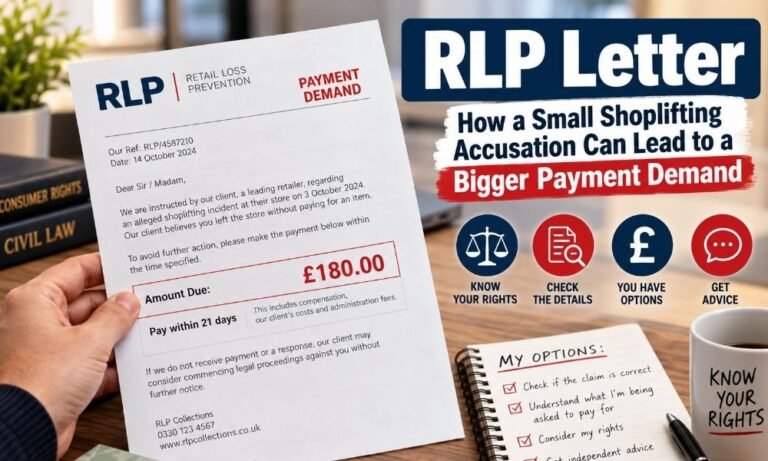
An RLP Letter can feel frightening when it arrives at someone’s home. The letter may come after a small shoplifting accusation, an unpaid item, or a mistake at a store checkout. For many people, the first shock is not only the accusation. It is the amount of money demanded. A small item can lead to a much bigger bill. That is why many people search for the meaning of an RLP Letter and want to know if they must pay it.
The Case That Made People Notice RLP Letters
One well-known example came up in a UK Parliament debate in March 2011. An MP described a case involving a 15-year-old girl who was accused of stealing goods worth £6 from a London store. After the incident, a demand was sent on behalf of the store asking for £137.50. The demand was said to cover the value of the goods, administration, security, and other costs. This case became a useful example because it showed the big gap between the value of the alleged goods and the amount later demanded.
This story matters because it shows why an RLP Letter can feel much larger than the original incident. A person may think the matter is over after leaving the shop, speaking to staff, or returning the item. Then a letter arrives days or weeks later. The amount may include more than the value of the goods. It may include staff time, admin costs, security costs, or investigation costs. For a young person, a parent, or someone with little legal knowledge, this can be very stressful.
What an RLP Letter Usually Means
An RLP Letter usually refers to a civil recovery demand from Retail Loss Prevention Limited. Retail Loss Prevention says it provides civil recovery services for businesses in the UK. These letters are often connected with retail incidents, such as alleged shoplifting or employee theft. The letter is not the same as a criminal conviction. It is also not the same as a court judgment. It is a civil demand, which means the business or its agent is asking for compensation.
Citizens Advice explains that a business may take civil legal action if it says someone caused it to lose money. This can happen when a person is accused of shoplifting, employee theft, or negligence. Citizens Advice also says a business might bring civil action instead of criminal action, or as well as criminal charges. This is why an RLP Letter can confuse people. It may sit beside police action, but it is not the same thing.
Why a Small Item Can Become a Bigger Demand
The main issue is cost recovery. A retailer may say the loss was not only the price of the item. The retailer may also claim it spent time and money dealing with the incident. Citizens Advice says businesses may claim for stolen cash or goods, staff investigation time, administration costs, legal costs, security costs, and other related costs. That is the basic reason a small alleged theft can turn into a much larger payment demand.
However, there is an important limit. Citizens Advice says the costs claimed must be reasonable. It also says that if a business claims staff investigation, administration, or security costs, it has to prove how much those costs were in that specific case. Citizens Advice says businesses cannot claim fixed costs for those items. This point is very important for anyone reading an RLP Letter. A demand is not automatically proof that the full amount is legally owed.
The Controversy Around Fixed-Sum Demands
The biggest controversy around an RLP Letter is the use of set amounts. In the 2011 Parliament debate, there was concern that some demands appeared to follow a fixed scale. The debate described examples where the demand rose depending on the value of the goods involved. Critics argued that this could put pressure on people to pay, even when the true loss was unclear.
Citizens Advice also raised concerns about fixed-sum civil recovery demands. In April 2011, Citizens Advice welcomed Law Commission proposals connected with unfair commercial practices. Citizens Advice said the Law Commission had confirmed there was no legal basis for fixed-sum demands in the alleged shoplifting cases Citizens Advice had examined. This does not mean every claim is false. It means the amount must be supported by proper facts, not only by a standard figure.
Why the Letter Feels So Serious
An RLP Letter may mention court action. That can make the reader feel panic. It may also make parents worry about their child’s record, job future, or credit score. The emotional pressure is part of why these letters became controversial. In the 2011 debate, concern was raised about young and vulnerable people receiving strong demands after low-value accusations.
Still, fear should not replace clear thinking. A civil demand is not the same as guilt being proven in court. Citizens Advice says a business can only claim compensation if it can prove in court that it is entitled to it. In a theft-related claim, the business must prove the person committed the theft, although the standard of proof in civil court is lower than in criminal court. So the key question is not only, “What does the letter say?” The better question is, “Can the claim be proven, and is the amount reasonable?”
What Readers Should Check First
Anyone who receives an RLP Letter should read it slowly. They should check the date, store name, incident details, reference number, amount demanded, and deadline. They should also check whether the letter explains how the amount was calculated. If the letter only gives a demand but does not explain the real loss, that may be important.
The person should also think about what actually happened. Was the item taken by mistake? Was it returned? Was there an admission? Was police action involved? Was the person under 18? Were there health, disability, language, or confusion issues? These facts can matter. They can affect whether the claim is strong, weak, or unclear. Citizens Advice says people should think about the strength of the evidence, whether guilt was admitted, and whether the losses claimed are reasonable.
Should You Pay an RLP Letter?
There is no single answer for every RLP Letter. Some people may choose to pay because they want the matter finished. Others may dispute the amount or deny liability. Some may seek advice before doing anything. Citizens Advice says options can include ignoring the letter, denying liability, making an offer of payment, or paying in full. It also recommends speaking to an adviser before deciding what to do.
Paying may reduce stress for some people, but it may also mean paying an amount that has not been tested. Ignoring the letter may avoid payment, but it can lead to more letters and still carries some risk. Denying liability may be suitable if the person disputes the claim, but it should be done carefully. Making an offer may be an option when someone accepts that some loss happened but questions the full demand. The safest step is to get advice before sending money or writing a response.
Can an RLP Letter Affect Your Credit Score?
An RLP Letter by itself is not the same as a County Court Judgment. A demand letter is only a demand. Credit problems usually become more serious if a case goes to court, a judgment is made, and the judgment is not handled properly. Citizens Advice says if a business takes someone to court and the person is proved to be in the wrong, they may have to pay legal costs as well as the amount claimed.
This is why people should not panic, but they should also not be careless. A letter can be the start of a civil process. It is not always the end. The smart response is to understand the claim, keep copies of all letters, avoid emotional replies, and seek proper advice if the amount is disputed or the facts are unclear.
Why This Story Still Matters Today
The 15-year-old girl’s case is still useful because it shows the human side of civil recovery. A £6 accusation and a £137.50 demand are not just numbers. They show how a small retail incident can become a family worry, a money problem, and a legal question. That is why the RLP Letter topic continues to attract searches.
Retailers have a real interest in stopping theft. Shops lose money from theft, fraud, damaged goods, and staff time. But consumers also need fair treatment. A fair system should not use fear, shame, or confusing legal language to collect money that cannot be properly explained. The strongest article on this topic should show both sides: retail losses are real, but payment demands still need evidence and reasonableness.
Final Thoughts
An RLP Letter can look simple, but it raises serious questions. It may follow a small accusation, yet ask for a much larger amount. The important point is that a demand is not the same as proof. A business may claim compensation, but it must be able to show that the claim is fair, reasonable, and connected to the real case. Anyone who receives an RLP Letter should stay calm, read the details, keep records, and get advice before making a final decision.
FAQs
1. What is an RLP Letter?
An RLP Letter is usually a civil recovery demand from Retail Loss Prevention Limited. It is often sent after a shoplifting or theft-related allegation. It asks for payment on behalf of a retailer or business.
2. Is an RLP Letter a criminal fine?
No. An RLP Letter is not a criminal fine and is not the same as a court judgment. It is a civil demand for compensation. Criminal matters and civil recovery are different legal processes.
3. Do I have to pay an RLP Letter immediately?
Not always. You should first check the details, the evidence, and how the amount was calculated. Citizens Advice recommends speaking to an adviser before deciding what to do.
4. Why is the amount higher than the item value?
The business may claim staff time, administration, investigation, security, or legal costs. But those costs should be reasonable and linked to the specific case. Citizens Advice says businesses cannot simply claim fixed costs for staff investigation, admin, or security costs.
5. Can an RLP Letter lead to court?
It can, but a demand letter itself is not court action. If a business does take court action, it would need to prove its case. If you receive court papers, you should get legal advice quickly.
