

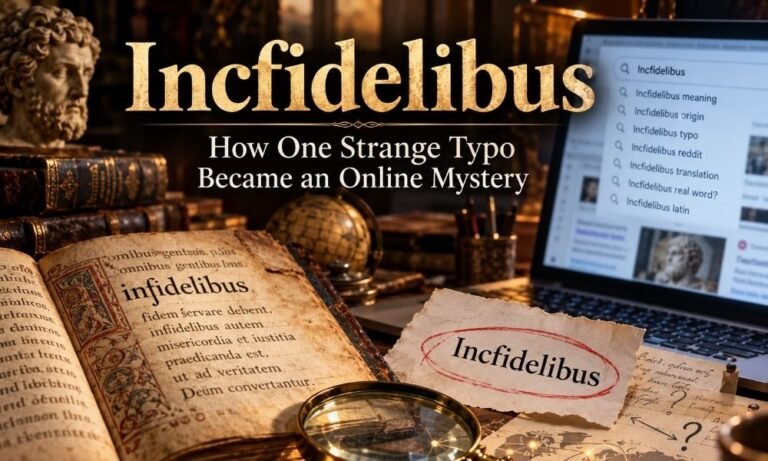
You see Incfidelibus on a website and stop for a moment. The word looks old. It feels important. Maybe it is Latin. Maybe it belongs to an ancient religious text, a forgotten book, or a coded message. That first impression is exactly what makes the word so interesting.
Then the mystery takes an unexpected turn. There is little reason to treat Incfidelibus as a standard Latin word with a well-established meaning of its own. A much stronger linguistic match is infidelibus, a real Latin form connected with infidelis. One extra letter may therefore be responsible for much of the confusion. Yet the mistake did not simply disappear. People searched for it, websites discussed it, and the strange spelling gained a digital life of its own.
Why Incfidelibus Looks Important at First
Part of the mystery comes from appearance. Incfidelibus does not look like an ordinary English typo. It looks structured and historical. Its ending resembles the endings readers often see in Latin words, while the middle of the term may remind English speakers of words such as “infidel” and “fidelity.”
That combination encourages people to assume there must be a deeper meaning.
A person unfamiliar with Latin may reasonably wonder whether Incfidelibus is an ancient term. Another reader may suspect that it has a religious meaning. Someone else might think it is the name of an organization, philosophy, book, or secret group.
The unusual spelling makes the term even more attractive. Familiar words are easy to ignore. Unfamiliar words create questions.
This is where the internet changes the story. In the past, a spelling error in a document might remain nothing more than a mistake. Today, people can copy it, search it, discuss it, and create pages about it. A typo can begin to look like an established term simply because it appears repeatedly.
The Real Word Behind the Incfidelibus Confusion
To understand Incfidelibus, it helps to look at the Latin word that most closely resembles it: infidelibus.
The underlying Latin adjective infidelis is well documented. Depending on context, it can carry ideas such as being unfaithful, faithless, unreliable, or unbelieving. Like many Latin words, its exact English translation can change according to the sentence and historical setting.
Infidelibus is an inflected form of that word. Latin changes word endings to show grammatical relationships. That means readers should be careful about taking one Latin form and assigning it a single English definition without considering the surrounding sentence.
The important difference is the spelling.
Incfidelibus contains an extra “c.” That small addition separates it from the recognized Latin form. There is not strong lexical evidence for treating Incfidelibus as an independent classical Latin term with its own established definition.
That does not make the search useless. In fact, the spelling mistake creates a much more interesting modern story.
How One Extra Letter Can Create a Mystery
The difference between infidelibus and Incfidelibus is tiny on the page. Yet linguistically, one letter matters.
Typing errors happen for many reasons. Someone may press the wrong key. A word may be copied incorrectly. Text recognition software can misread an old document. A writer may reproduce a spelling found on another website without checking the original source.
Once an error is online, repetition can make it appear credible.
Imagine one page publishes Incfidelibus. Another writer sees it and assumes it is correct. A third website rewrites the second article. Search engines then have several pages containing the same unusual spelling.
To an ordinary reader, repetition can look like confirmation.
But ten pages repeating one unsupported claim do not automatically create ten independent pieces of evidence. They may all lead back to the same mistake.
This is one reason Incfidelibus is a useful case study. It demonstrates the difference between information being common online and information being well supported.
Why People Keep Searching for Incfidelibus
A strange keyword creates what might be called a curiosity gap. People know enough to become interested but not enough to feel satisfied.
Suppose you search for “table.” You already know what a table is. There is little mystery.
Now suppose you encounter Incfidelibus.
Immediately, questions appear. What language is it? What does it mean? Is it religious? Is it historical? Why have I never heard it before? Is there something hidden behind it?
Those questions encourage another search.
The lack of a simple answer can increase curiosity rather than reduce it. When different pages offer different explanations, readers may continue looking. Each search becomes another signal that the keyword attracts attention.
The strange situation is that uncertainty itself can help keep a term alive.
Incfidelibus and the SEO Content Problem
This leads to a larger issue in online publishing.
Search engine optimization, or SEO, helps publishers understand what people are searching for and create useful pages around those needs. There is nothing inherently wrong with that. Good SEO content can answer questions clearly and save readers time.
Problems begin when the keyword becomes more important than the truth.
A rare term such as Incfidelibus can tempt a publisher because competition may appear low. A writer may notice that people are searching for it and decide to produce an article. But there may not be enough reliable information to support a long explanation.
That creates a choice.
A careful writer says, “The evidence is limited. Here is what can actually be established.”
A careless writer fills the information gap with confident-sounding claims.
The second approach can create an entire fictional history around a typo. A strange spelling may suddenly be described as an ancient philosophy, forgotten movement, symbolic concept, or cultural tradition without reliable primary evidence.
That may make an article sound exciting. It does not make it accurate.
When Search Results Create False Confidence
One of the biggest lessons from Incfidelibus is that search results require interpretation.
People sometimes assume the first explanation they find must be correct. They may also believe that a claim becomes stronger when several websites repeat it.
Neither assumption is always safe.
When researching an unfamiliar term, ask where the definition came from. Does a recognized dictionary document it? Can the word be found in reliable historical texts? Do academic or linguistic sources support the claimed origin? Are different websites providing independent evidence, or are they simply repeating similar wording?
These questions are especially important when a term is supposedly ancient.
If someone claims that a word has been used for hundreds or thousands of years, there should normally be evidence beyond modern blog posts.
That is why established Latin dictionary resources are more useful for this question than a page that simply declares a dramatic meaning without explaining its evidence.
What Incfidelibus Teaches Us About Checking Strange Words
Readers do not need to become professional linguists every time they find an unfamiliar word. A few simple checks can prevent a lot of confusion.
First, search for close spellings. Removing the “c” from Incfidelibus quickly produces a form that fits known Latin vocabulary much better.
Second, look for the root word. In this case, infidelis provides an important linguistic connection.
Third, compare specialist references with general websites. Dictionaries, historical texts, academic resources, and established reference works usually deserve more weight than anonymous articles with no sources.
Fourth, pay attention to uncertainty. A responsible source may use phrases such as “likely,” “appears to be,” or “the available evidence suggests.” That is not weakness. It is often a sign that the writer understands the limits of the evidence.
Finally, do not confuse repetition with proof.
These habits work far beyond Incfidelibus. They can help with viral quotes, supposed historical facts, medical myths, celebrity rumors, and unusual words that suddenly become popular.
Why Humans Want Incfidelibus to Have a Deeper Meaning
There is also a human side to this mystery.
People are natural pattern seekers. When we encounter something unfamiliar, we try to connect it with things we already understand.
Incfidelibus looks too elaborate to feel like random typing. Its Latin-like shape makes it seem as though somebody must have created it intentionally. The brain begins looking for a story.
That reaction is understandable.
Mystery is also more entertaining than error. “A forgotten ancient term has returned online” sounds more exciting than “someone may have added a letter.”
But the simpler explanation can tell us something more valuable.
The interesting part of Incfidelibus may not be what the word supposedly meant centuries ago. The interesting part may be what modern people did with it. We saw an uncertain term, searched for meaning, repeated explanations, and gradually turned a questionable spelling into a recognizable internet keyword.
The mystery, in other words, was created by our reaction to the word.
Is Incfidelibus a Secret Code or Ancient Phrase?
There is no strong reason to describe Incfidelibus as a secret code, mysterious organization, forgotten philosophy, or independently established ancient Latin phrase.
Those claims would require evidence.
The safer explanation is much less dramatic: Incfidelibus appears to be a nonstandard spelling closely related to infidelibus.
That distinction matters for anyone publishing an article about the term. Writers should not turn uncertainty into fact merely because a more dramatic explanation might attract clicks.
There is still plenty to discuss without inventing history.
The typo itself is the story.
It gives us a practical example of how language changes online, how search engines preserve unusual spellings, and how people can give accidental terms a second life.
What Does Incfidelibus Actually Mean?
The most accurate answer requires a little caution.
Incfidelibus itself does not have a clearly established independent meaning that should be presented as certain. The closest supported Latin connection is infidelibus, derived from infidelis.
Depending on grammatical and historical context, infidelis can relate to being unfaithful, faithless, unreliable, or unbelieving. Translating Latin correctly requires context, so even the recognized word should not automatically be reduced to one English meaning in every situation.
This is an important difference between careful explanation and keyword content.
A weak article may give Incfidelibus one dramatic definition and stop there.
A useful article explains the spelling problem first, identifies the likely Latin connection, and tells readers where uncertainty remains.
That approach may sound less sensational, but it gives the reader something far more valuable: a clear answer.
Why a Typo Like Incfidelibus Can Survive Online
Internet language does not always follow dictionary rules.
Usernames, hashtags, memes, brand names, spelling mistakes, abbreviations, and invented expressions can all become searchable terms. Once enough people encounter an unusual string of letters, the term can develop an online presence even if it did not begin as a recognized word.
Search behavior can then reinforce that presence.
Someone sees Incfidelibus and searches it. A publisher notices the search. The publisher writes about it. Another reader discovers that page and searches the term again. More pages appear.
Eventually, the question “What is Incfidelibus?” becomes meaningful even if Incfidelibus itself began as an error.
This is a fascinating feature of digital culture. Search engines do not only help us discover established knowledge. They also record our confusion.
In some cases, that confusion becomes part of the internet’s vocabulary.
The Bigger Lesson Behind the Incfidelibus Mystery
Incfidelibus may look like a small language puzzle, but it highlights a major challenge of the modern web.
Information is easy to publish. Verification takes more work.
A confident paragraph can be written in minutes. Checking a Latin dictionary, tracing an original source, comparing spellings, and admitting uncertainty require more care.
Readers therefore need a simple rule: unusual claims deserve stronger evidence.
When a mysterious word appears online, do not assume the strangest explanation is the best one. Check its spelling. Find its linguistic roots. Look for older evidence. Compare trustworthy references. Ask whether different articles actually provide proof.
Sometimes that investigation uncovers a fascinating forgotten history.
Sometimes it uncovers one extra letter.
Both results are useful when they are true.
Final Thoughts
Incfidelibus became interesting not because we can confidently point to a secret ancient meaning, but because its uncertainty created a modern internet mystery. The word looks convincing enough to inspire curiosity, while its close similarity to the recognized Latin form infidelibus provides a much simpler explanation.
That simplicity is exactly what makes the story valuable. One possible typo can be searched, copied, discussed, and eventually treated like a subject in its own right. Along the way, it exposes how easily repetition can look like evidence and how SEO content can amplify uncertain information.
So when you next encounter Incfidelibus, there is no need to search for a hidden society or forgotten code. Start with the letters themselves. The real mystery is not necessarily what Incfidelibus meant in the distant past. It is how one strange spelling persuaded the modern internet that there had to be a mystery at all.
