

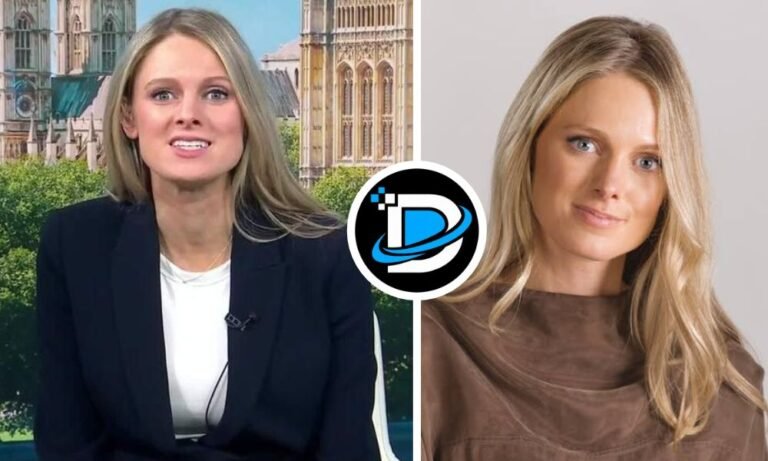
A search for Ali Fortescue Husband may seem like a quick way to find a simple answer. Yet the pages that appear do not all tell the same story. Some use firm words about marriage. Others say the facts are still unclear.
This raises a bigger question: how can readers tell what is true when several sites share similar claims?
The answer starts with checking where a claim came from. An old report may support one small fact. Later stories may add more than that report can prove. Following that trail helps us see where evidence ends and guesswork begins.
What Can We Say About Ali Fortescue?
Before looking into Ali Fortescue Husband, it helps to know who she is. Ali Fortescue is a presenter and political correspondent at Sky News. Her official work page describes her reporting on British politics and her interviews with government ministers.
She worked at the BBC before joining Sky News. Her Sky profile also notes awards and praise for her reporting on abuse at a care home in Margate. These are clear career details from her employer.
Her work page does not name a husband. That does not prove she is single. A work profile has a narrow purpose. It tells readers about a person’s job, rather than every part of their life.
Following the Claim Back
The Ali Fortescue Husband search leads to a useful earlier source: a Peerage News blog post dated December 4, 2019.
The post reports an engagement between Alexandra Kate, known as Ali, Fortescue and Richard Frederick C. Alliott. It identifies Fortescue as a Sky News reporter. That job detail helps connect the notice to the journalist discussed here.
However, there is a key limit. This is a blog report of an engagement announcement. The page does not itself provide a wedding report.
It is an early source found during this review. Calling it the first source ever would go too far. There may be an earlier notice elsewhere that this review did not locate.
An Engagement Is Not a Wedding
For the Ali Fortescue Husband question, one word makes a large difference: “engaged.”
An engagement means that two people plan to marry. A wedding means that they have married. Evidence of the first event does not, by itself, prove the second.
This does not mean a wedding did not happen. It means a writer needs more evidence before reporting one as a confirmed event.
A careful sentence would say that a 2019 blog post reported an engagement. A less careful sentence might turn that into a claim about a husband today.
Both sentences may sound close. But they make different claims, and they need different levels of proof.
Where Later Accounts Differ
Later Ali Fortescue Husband coverage shows why readers should check more than a headline.
A LongMagazine article says Fortescue is married to Alliott. It points to an engagement announcement and also describes later birth notices as support. Those later notices were not independently verified in this review. Its marriage claim therefore cannot be treated here as a checked fact.
A GlobeGist article takes a less certain view. It discusses the reported engagement but says a wedding has not been clearly confirmed in its account.
These pages make different claims. Their differences do not tell us which account is right. They show why a reader must examine the evidence each page offers.
Similar Claims Do Not Prove Copying
It would be easy to turn Ali Fortescue Husband coverage into a story about websites copying one another. Yet that claim also needs proof.
Two articles can mention the same name because they used the same earlier notice. They might have done separate research. One might have used the other. Similar facts alone cannot settle that question.
This review did not establish a full chain of copying between the sites.
What it did find was an important gap between an engagement report and later statements about marriage. That gap is enough to explain the risk without accusing any publisher of conduct that has not been shown.
How a Claim Can Grow
The Ali Fortescue Husband topic offers a simple way to understand how claims can change as they travel.
Imagine this made-up example:
- One page says a couple announced an engagement.
- Another says the couple is likely married.
- A third drops “likely” and calls them married.
- A short search preview shows only the firm claim.
This example explains a possible process. It is not a proven account of how these specific articles were written.
The change can be small at each step. Still, the final statement may be much stronger than the first source. Readers may never see the missing words that once showed doubt.
Why Repeated Words Feel Strong
When readers see Ali Fortescue Husband beside the same name on several pages, they may feel they have found agreement.
But agreement and separate proof are different things.
Think of five friends sharing news from one message. There are five people telling the story, but there is still only one message behind it. If that message is wrong or unclear, the group has not fixed the problem.
Web pages can work the same way. Several pages may rely on one old report. Counting those pages does not tell us how many people checked the claim.
A better question is: what new evidence does each page add?
Search Previews Leave Things Out
An Ali Fortescue Husband search result gives readers only a small slice of a page. A title may sound certain while the full text includes doubt.
That is why opening the page matters. Look for the sentence that makes the main claim. Then look for a link, a date, or a named source beside it.
A preview can help you choose what to read. It cannot replace reading the evidence.
Also, a page appearing near the top of a search does not show that its marriage claim has been checked. Readers still need to judge the source behind the words.
Dates Need Care Too
Dates matter when checking Ali Fortescue Husband stories. A report from 2019 tells us what was reported then. It cannot, on its own, explain someone’s life years later.
A newer date on an article also needs care. It may show when the page was posted or changed. It does not tell readers which facts were checked again.
Look for a clear link between the date and the event.
Was the engagement reported on that date? Did a wedding take place then? Was the article simply updated? Keeping those questions apart helps stop old information from looking like fresh proof.
Silence Does Not Give an Answer
Some Ali Fortescue Husband stories try to explain why personal details are hard to find. They may say she wants to protect her family or keep work and home apart.
Those reasons may sound fair. But unless she has stated them, they remain guesses about her thoughts.
The safe approach is simple: describe what the checked sources say. Do not turn missing details into a story about someone’s feelings.
A person can share little online for many reasons. Readers do not need to choose a reason to accept that some facts remain outside the evidence available to them.
What Would Stronger Proof Look Like?
A stronger Ali Fortescue Husband article would connect its main claim to clear evidence.
That could include a direct public statement, a properly checked wedding notice, or a reliable interview that clearly identifies a spouse.
Even then, the source must match the right person. Similar names can cause mistakes. A shared surname or matching first name is not enough.
A writer should also check what the source actually proves. A family notice may support a specific event. It may not support claims about someone’s job, wealth, home life, or reasons for avoiding publicity.
Evidence has limits, even when it is real.
A Quick Check for Readers
Before sharing an Ali Fortescue Husband story, readers can use a short check:
- Find the source behind the main claim.
- Read the source rather than only its headline.
- Check the event date and the posting date.
- Notice words such as “may,” “reported,” and “confirmed.”
- Ask whether other pages add separate evidence.
- Leave room for an answer that remains unclear.
For Ali Fortescue Husband, this means keeping the reported engagement separate from a confirmed wedding.
The check does not require special skills. It requires a little time and a willingness to stop when the evidence stops.
What Publishers Should Fix
Publishers writing about Ali Fortescue Husband can help readers by making their level of certainty clear from the start.
If an article relies on a reported engagement, its wording should say so. If it claims there was a wedding, it should show the evidence for that extra step.
A title should match the strength of the article. A firm headline followed by cautious text can leave readers with the wrong impression.
When new evidence changes a story, a clear correction helps. Explain what changed and why. Readers should be able to see how the article reached its answer, without having to guess.
The Answer the Evidence Supports
The most useful answer to Ali Fortescue Husband is a careful one. This review found a 2019 blog report of an engagement to Richard Frederick C. Alliott. It also found later pages that differ in how firmly they describe a marriage.
It did not independently confirm a wedding or establish which sites copied another.
That is a limit of this review, not proof that a marriage claim is false.
The Ali Fortescue Husband search teaches a wider reading skill: separate what a source reports from what later writers assume. A claim needs evidence that fits its exact meaning.
When reading Ali Fortescue Husband coverage, the number of pages is less useful than the strength of their sources. Follow the links, check the wording, and keep unanswered questions open.
